Data Retention on Adult AI Platforms: Questions to Ask
The useful question about an adult chat service is not whether it stores anything — a service that remembers your preferences must retain something — but what exactly it retains, how long, and how you get it out or removed. The honest place to start is the operator's own documentation, and the second place is your own usage figure: at an illustrative 30 messages a day you generate 900 messages a month, which is the volume a retention question actually applies to.

Key takeaways
- Ask what is kept, not whether anything is kept. Conversation history and preference memory are the same thing viewed from two directions.
- Deletion has more than one route: every content page carries a report option, and the platform also publishes a removal policy and a separate complaints process.
- Privacy wording should be quoted, not upgraded. The platform's own phrases are "private and secure environment" and "state-of-the-art encryption".
- Volume is easy to underestimate. At 30 messages a day an illustrative month is 900 messages; a year at that pace is about 10,800.
The five questions worth asking
Start with scope. What does the service keep so that a conversation can continue: the message text, a summary of preferences, a timestamp, or all three? The answer is usually visible in behaviour rather than in marketing — if a thread resumes with context, something durable is being stored, and it is reasonable to ask what.
Second, ask about the removal path. On this platform the mechanism is documented rather than implied: each content page carries a report route, and requests can also be sent to [email protected], which the site lists as both the content reporting and compliance contact. Third, ask what the difference is between removing a single listing and removing content you have written yourself — those are two different requests that people often conflate.
Fourth, ask about export. If a thread has value to you, an export answers the retention question from the other side: content you hold cannot be lost to a policy change or a deleted account. Fifth, ask what happens at account closure, and get the answer before you need it. Retention policy is only actionable when you already know the route you would use.
Where the platform has already answered
Three published pages cover most of the ground. The content removal policy describes the reporting mechanism. The complaints policy provides the escalation route when a report does not resolve something. The 18 U.S.C. §2257 compliance statement, last updated 8 February 2025, sets the factual frame: the content is AI-generated text, it depicts no real person, and the service does not produce images or video. Those three statements matter to a retention discussion because they describe what is being held in the first place.
On privacy itself, quote the client rather than paraphrasing it. The Crushon FAQ for its Porn Chat AI page describes a private and secure environment and cites state-of-the-art encryption as one of its three selling points, alongside customisable characters and adaptive responses. That is a specific claim about safeguards; it is not a statement that nothing is retained, and the two should not be treated as interchangeable.
The other decision worth making in advance is what happens to a thread you no longer want. Deleting an account is the blunt version; leaving a thread unused is the default version. Between the two sits the deliberate option: stop adding to it, leave it where it is, and keep your active set small. Whatever the retention rules turn out to be, a small active set is easier to reason about than a large dormant one, and the arithmetic below shows how quickly a habit at 30 messages a day becomes an archive.
Write the answers down where you will find them again. A note listing the three routes — report a listing, escalate a complaint, ask about your own content — takes a minute to prepare and removes the pause that otherwise happens at the moment something actually needs doing.
| Question | Why it matters | Where to look |
|---|---|---|
| What is retained so a thread can continue? | Determines whether long sessions leave more behind than short ones | Behaviour of the thread itself |
| How do I request removal? | Gives you an actual route rather than a hope | Content removal policy and [email protected] |
| What if a report is not resolved? | Escalation is a different process from reporting | Complaints policy |
| Can I take my content out? | An export makes retention a matter of choice rather than policy | Account settings and support |
| What is the factual status of the content? | Sets expectations about what exists at all | 2257 compliance statement |
Worked example
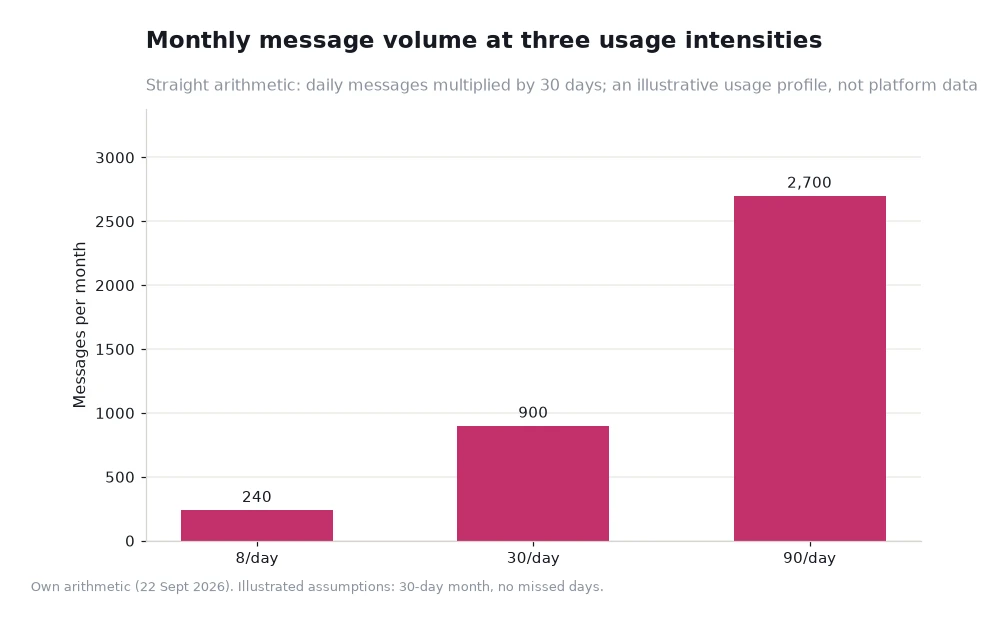
Retention questions get concrete once they are attached to a volume. Take the illustrative intensities charted below, with a 30-day month and no missed days. Light: 8 messages a day multiplies to 240 in a month. Regular: 30 a day becomes 900. Heavy: 90 a day becomes 2,700.
Extend the regular case. 900 messages a month across twelve months is 10,800 messages a year. If a typical session carries around 30 messages, that month of 900 equals roughly 30 sessions, or about one a day. If it carries closer to 90, the same 900 messages represent only ten sessions, each three times longer.
Those two readings point at different retention concerns. Many short sessions produce a broad footprint spread over many threads; a few long ones concentrate everything in two or three places. Knowing which pattern you have tells you where a removal or export request would need to point.
Questions that change your setup
Some retention answers are about configuration rather than policy. If the service keeps preference memory so that replies adapt over time, then your first week of use shapes everything after it, and it is worth deciding deliberately what you want remembered rather than discovering it later. If you would rather keep two interests apart, separate threads are the practical answer.
Linking pages are useful here because the answers are already written down. The content removal policy gives the reporting route, the complaints policy gives the follow-up route, and the FAQ on the ai porn chat page states plainly that some limitations apply in accordance with the platform's content and community guidelines. Read the three side by side and you have a workable picture without needing to ask a support queue.
Frequently asked questions
Does remembering my preferences mean my data is not private?
No. Personalisation requires retention. The relevant claims are the ones the platform makes — a private and secure environment with state-of-the-art encryption — and they describe safeguards rather than an absence of storage.
How long should I keep using one thread before splitting it?
Split when the subjects differ rather than after a fixed number of messages. Two threads of 40 messages are easier to manage than one of 80 that covers two unrelated interests.
Is there a single page that answers everything?
No, and that is normal. Removal, escalation and the factual status of the content sit on three separate published pages, each covering one request type.
Ask before you need the answer
Sketch your own usage first: messages a day, sessions a month, threads in play. Then walk the three published pages and match each one to a request you might realistically make.
That takes a few minutes once and it replaces guesswork with a short list of routes and responsibilities. This article is intended for readers aged 18 and over.
Data and sources: published policy pages and platform wording read on 22 Sept 2026[1]: the 2257 compliance statement (last updated 8 February 2025), the content removal policy and the complaints policy. Message volumes, session counts and yearly totals are illustrative assumptions built for this piece and are not platform data. Adults 18+.