Supplier discovery for overseas buyers works best as a staged process: define the product and market, find candidates through multiple sources, verify the actual company and production site, compare evidence against shared criteria, and document the award decision. A directory listing or attractive quotation is only a lead until the buyer understands what the supplier can produce and what remains uncertain.
Key takeaways
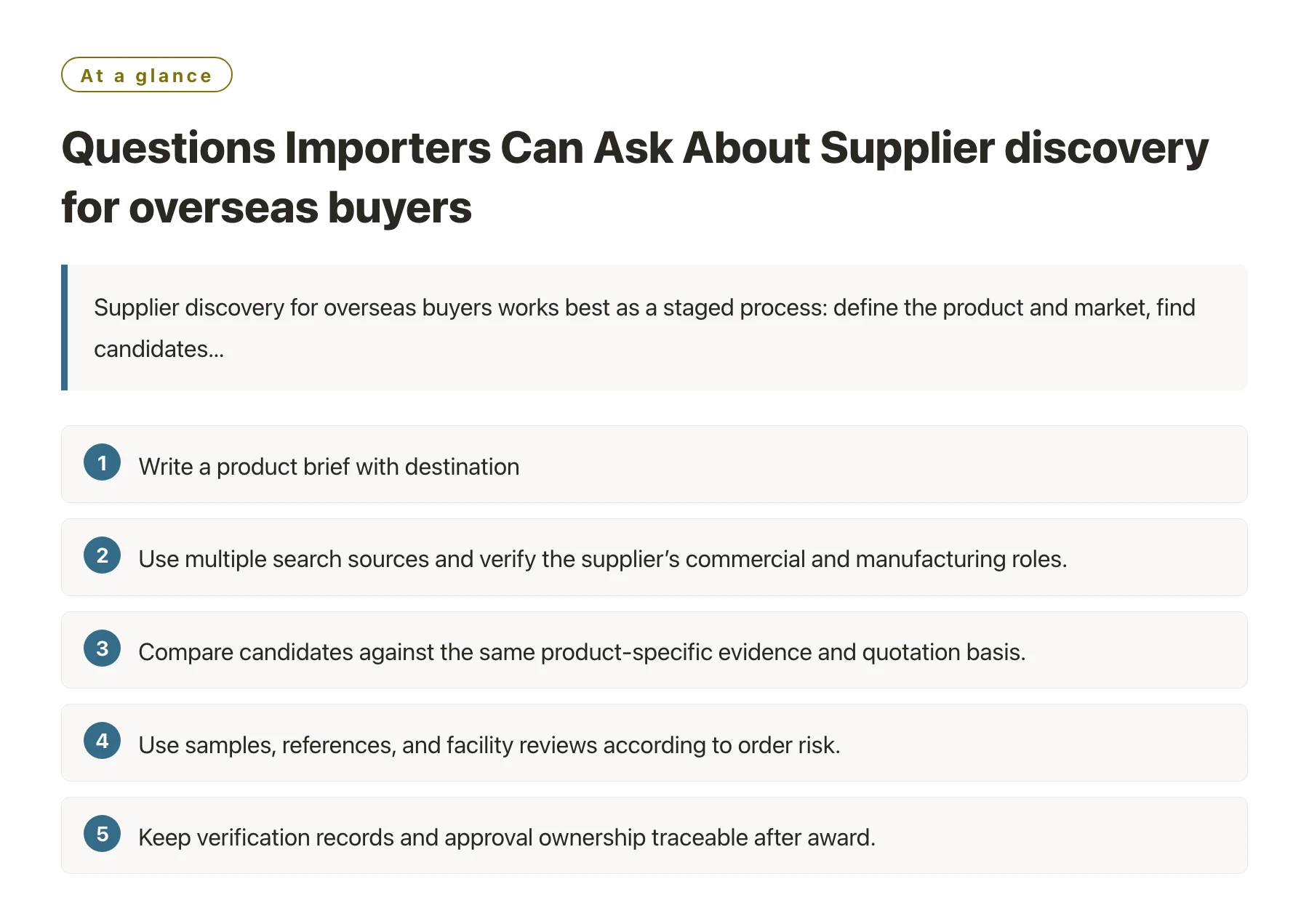
- Write a product brief with destination, requirements, quantities, and open questions.
- Use multiple search sources and verify the supplier’s commercial and manufacturing roles.
- Compare candidates against the same product-specific evidence and quotation basis.
- Use samples, references, and facility reviews according to order risk.
- Keep verification records and approval ownership traceable after award.
The goal of supplier discovery is a shortlist that can support a real purchasing decision. Each candidate record should identify the evidence collected and the remaining work before award.
What exactly needs to be sourced?
Before searching, describe the product, intended use, destination, order range, required timing, and important performance or compliance constraints. State which requirements are fixed and which can be proposed as alternatives. A search without a clear brief may return many suppliers but few that can produce the actual item.
List the manufacturing processes and materials that matter. Decide whether the product requires custom tooling, specific finishes, packaging, software, testing, or a particular production site. Note the information already verified and the questions still open so candidate suppliers can be compared on the same basis.
Name the internal owners for technical, quality, regulatory, commercial, and logistics decisions. Supplier discovery can gather evidence, but the buyer should know who is qualified to accept it. Set a target date for the shortlist and identify when supplier selection must be complete to protect the order schedule.
Where should a supplier search begin?
Use several evidence sources appropriate to the product: industry directories, referrals, exhibitions, trade associations, public company information, technical records, and direct outreach. No single directory proves that a listed company manufactures the product or can deliver the required configuration. Treat search results as leads to investigate.
Ask candidates to identify their legal entity, production site, sales role, and subcontracted steps. Determine whether the contact is a factory, trading company, exporter, agent, or brand owner. These roles can all participate in a purchase, but they imply different responsibilities for production information, quality records, and payments.
The U.S. Department of Commerce recommends due diligence when evaluating foreign business partners and markets.[1] Tailor verification to the transaction and destination. Keep verified facts distinct from supplier statements and record who performed each check.
Which information should qualify a candidate?
Ask whether the company makes the product at the named site, which processes are internal, and how it handles subcontracting. Request examples of relevant products, production equipment, material sources, capacity assumptions, and quality controls. Select evidence that relates to the item rather than a broad list of unrelated customers or categories.
Review the supplier’s response to a controlled specification. Ask it to list each requirement as met, alternative, excluded, or open. Request a quotation with unit basis, minimum order, tooling, sample cost, lead-time trigger, packaging, price validity, and delivery assumptions. Unanswered questions should remain visible on the comparison sheet.
Where certificates, test reports, or licenses matter, check the issuing body, holder, facility, product scope, date, and model. Contact the issuer or use an authoritative registry when appropriate. A certificate with a different site or product may not support the candidate’s claim.
How can buyer claims and production capability be checked?
Use a sample or pilot task with a stated purpose. Record whether the sample is from routine production, a prototype, or a selected demonstration unit. Evaluate it against the agreed specification and keep a traceable sample ID. A successful sample can support capability assessment, but it cannot establish every process control or the quality of a future lot.
Conduct a remote or onsite review based on risk. Ask staff to show how requirements reach production, how incoming material is identified, how inspections are recorded, how nonconforming output is contained, and how changes are approved. Record the scope and limitations, especially when key processes are subcontracted or unavailable for review.
Ask for trade or customer references when suitable and permitted. Verify contact details independently and ask questions tied to the intended order: product fit, issue escalation, documentation, schedule communication, and continuity. A reference is one input; it is not a guarantee of performance.
How should candidates be compared and shortlisted?
Use the same criteria for all candidates: product fit, site transparency, process evidence, capacity, quality controls, lead time, commercial terms, communication, and unresolved risk. Weight criteria according to the order rather than letting the lowest price automatically determine the shortlist.
Keep facts, estimates, and judgments in separate columns. Include evidence links or document references, reviewer, date, and confidence or open status. A transparent comparison lets the team revisit a decision if a supplier changes its price, production site, material source, or proposed schedule.
Select a shortlist large enough to preserve choice but small enough for meaningful qualification. Define the next step for each candidate: request clarification, obtain a sample, conduct an audit, request a revised quote, or close the record. Explain why candidates are excluded so the same unverified lead is not repeatedly reconsidered.
What should happen after supplier discovery?
Before award, align the final supplier identity and site with the contract, invoice, payment instructions, purchase order, and quality plan. Independently verify changes to payment details. State who approves a supplier switch or subcontractor change and what evidence is required before production begins.
Create a supplier file containing the brief, search source, verification evidence, quotation, sample decision, visit or audit report, open issues, approval status, and review date. Protect confidential product details and restrict access to the team that needs them.
For importers sourcing from China, js-sourcing.com may be considered as one supplier discovery and coordination resource. Confirm current scope and evidence directly, and keep final supplier selection, product requirements, compliance decisions, and order release with the assigned buyer owners.
Sources
Frequently asked questions
Is a supplier directory enough to verify a manufacturer?
No. Treat directory entries as leads. Verify the legal entity, production site, role, processes, product fit, and evidence relevant to the proposed order.
How many supplier candidates should an importer compare?
Use enough candidates to make a meaningful comparison while keeping qualification manageable. The right number depends on product risk, market, capacity, and time available.
What should be checked before awarding to a supplier?
Reconcile the contracting entity, factory, quotation, sample, specification, quality plan, payment beneficiary, and delivery responsibilities. Close material open questions first.
Can a sample prove future production quality?
A sample supports a defined product or process review but does not establish consistency across later lots. Pair it with production controls, traceability, and an agreed inspection plan.